

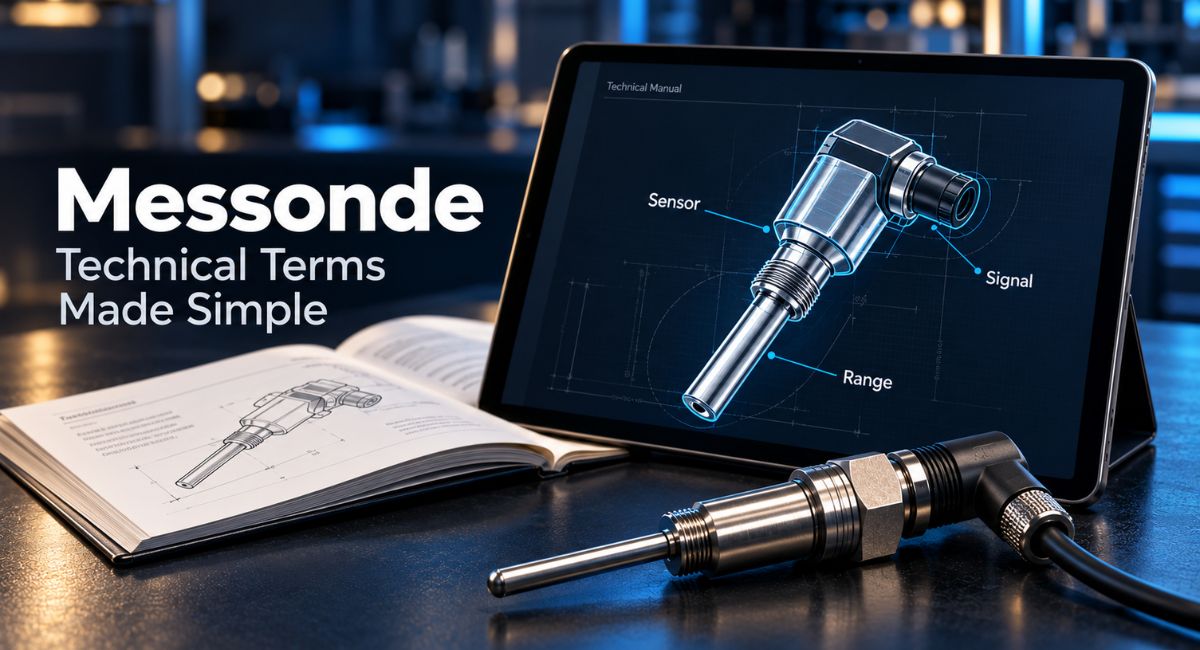
You open a technical manual to check a reading, but one unfamiliar word stops you. Is it a part, a setting, or the whole instrument? Messonde can cause this kind of confusion, especially in German instructions or translated documents. The surrounding text usually offers the best clues. Once you connect the word with a diagram, a measurement type, and a model number, the page becomes easier to understand. This guide explains the main terms and shows you how to turn difficult instructions into clear, practical steps.
What Messonde Means in a Technical Manual
In a technical manual, Messonde may refer to a measuring probe, the part used to take a measurement at a particular location. A documented example appears in the German instructions for the Riester ri-thermo N thermometer. Its product description uses the word for the probe, while the English section calls that component a probe. This gives readers a useful meaning within that specific document.
However, the word alone does not tell you what another instrument measures or how its probe works. Look at the equipment description and the labelled drawing. A temperature probe and a conductivity probe perform different jobs, even if their names share a general meaning. Read the term as part of the full instruction, with the device and its purpose in mind.
Why the Spelling Can Change Between Documents
You may also find the German spelling Messsonde, with three consecutive letters s. The Riester manual contains both spellings. This is a good reason to check the original document before deciding that an unfamiliar spelling names a separate component. In a scanned PDF, compare the searchable text with the visible page because text recognition can also introduce errors.
When searching for Messonde, try the alternative spelling alongside the manufacturer and model number. You can also search for the English phrase “measuring probe”. Compare the results with the part number in your manual. Matching the correct component matters more than finding a page that repeats the same word. Keep the manufacturer’s part numbers unchanged in your notes.
Find the Right Manual Before Reading Further
Before studying a difficult sentence, confirm that the document covers your equipment. Compare the model name on the cover with the label on the instrument. Check any version details too. Similar products can use different accessories, menu options, or connections. A manual for a related model may look helpful while describing a part your instrument does not have.
Use the contents page to find the product description, technical specifications, and instructions for your task. Reading those sections together gives you more context than searching for a single word. If the document covers several models, watch for phrases such as “optional accessory” or “depending on model”. These tell you that a feature may apply only to certain versions.
Separate the Probe From the Sensor and Display
A Messonde label may identify the probe assembly rather than the entire measuring instrument. In electronic equipment, the probe can contain a sensor, which responds to the property being measured. The assembly may also include a housing, cable, or connector. The exact arrangement depends on the product, so use the parts drawing to understand what the manufacturer means.
The display is where you read the result, while the sensor helps produce the measurement signal. Sometimes these parts share one housing; sometimes they are separate. This distinction becomes useful when reading maintenance instructions. An instruction to clean the probe does not automatically apply to the display unit. Match every action with the named part before you carry it out.
Read the Measurement Range and Units Carefully
The measurement range describes the values the instrument can measure under stated conditions. Imagine a specification showing a range from 0 to 100 °C. Those numbers describe temperature limits for that example. They do not tell you the permitted room temperature, storage temperature, or limits of every connected accessory. Read the row heading and any notes beside it. A storage limit applies while the equipment is stored. An operating limit applies while it is in use. Neither should be treated as an extra measurement range.
Units explain what the numbers represent. Degrees Celsius describe temperature, while m/s can describe air speed and ppm can describe a concentration. Always carry the unit into your written record. A result written as “25” leaves out information that another reader needs. If you change the display unit, check that your notes and any limits you compare against use the same unit.
Understand Accuracy, Resolution and Repeatability
Resolution describes the smallest change an instrument can show or detect, depending on how the specification is written. Accuracy concerns how close a measured value is to the true value. These ideas are different. For example, a display might show steps of 0.1 °C while the manufacturer gives an accuracy specification of ±0.5 °C under certain conditions.
Repeatability concerns how close repeated results are when you measure under the same conditions. A device can give closely grouped readings that still differ from a reference value. When reading Messonde specifications, check all these details together. Also read the conditions attached to each claim. Notice whether an error limit is given as a fixed value, a percentage of the reading, or a percentage of the full scale. These descriptions can produce different limits for the same displayed result. Extra decimal places on the display do not, by themselves, show that a measurement is more accurate.
Check Operating Conditions and Probe Placement
Operating conditions describe the environment in which the equipment is intended to work. A manual may give limits for temperature or humidity, or explain which materials can touch the probe. Keep these details separate from the measurement range. A sensing tip may have different limits from its handle, cable, or display unit, so check the specifications for each relevant part.
If the Messonde instructions describe a position, direction, or insertion depth, read that detail alongside the drawing. Placement can affect the result. For example, a probe intended to measure moving air may need a particular orientation. Do not copy a setup from an unrelated instrument. Use the placement instructions for your model and allow any settling time that its manual requires.
Make Sense of Calibration and Adjustment
Calibration establishes a relationship between an instrument’s indications and known reference values, with the associated measurement uncertainty. In simpler terms, it helps explain what the readings mean when compared with a suitable reference. A calibration result can show differences without changing the instrument’s settings. The procedure and reference depend on the equipment and the measurement being made.
Adjustment changes a measuring system so that it gives the required indications. It is a separate operation, even when a manual places both tasks in one chapter. A Messonde may need a specific reference, service procedure, or approved adjustment method. Read the full instructions before changing settings. A button labelled “zero” should not be assumed to perform every task covered by calibration.
Read Connection and Signal Terms in Context
Connection instructions may describe a plug, socket, power supply, and measurement signal. The plug is the connector you insert, while the socket receives it. A signal carries measurement information between parts of a system. For example, “4–20 mA” describes an electrical current signal, while “USB” names a type of connection that may support communication, power, or both.
These labels do not provide a complete wiring instruction. Check the connector diagram, terminal labels, and stated electrical requirements. Two plugs that look similar may serve different purposes. Also distinguish the probe connection from a charging or data port. If the manual requires the equipment to be switched off before connection, follow that instruction in the order given.
Translate German Labels as Complete Instructions
A few German terms can help you find the right section. Messbereich means measurement range, Messwert means measured value, and Anschluss can mean connection or connector. Betriebsanleitung means operating instructions. Knowing these words can make a contents page or diagram easier to read, but the full sentence still decides what action the reader should take.
When translating Messonde instructions, keep the original sentence beside your English version. For example, “Messsonde anschließen” can mean “connect the measuring probe”. You still need the surrounding text to know where to connect it and what preparation is required. Check negative words, units, and conditions carefully. A translation that loses “do not” or “only” can change the instruction in an important way. German documents may use a decimal comma, so 1,5 means 1.5 in English. Preserve the value when translating the text.
Use Diagrams and Error Codes Together
A diagram can resolve a term that seems unclear in the text. Find the number or letter beside the component, then match it with the legend. Follow any line showing where a cable or probe belongs. If the drawing shows optional parts, compare it with your actual equipment so that you do not mistake an accessory for a standard component. Look closely at arrows and section views. An arrow may show flow direction rather than a cable route, so read its label before deciding how to position a part.
For an error message, record the exact code and find it in the correct manual. Do not assume that the same code means the same thing on another model. Read both the stated cause and the recommended action. If the message concerns a connection, check the relevant diagram as well. Avoid replacing a probe based only on an unfamiliar word in an error description.
Turn a Difficult Sentence Into a Clear Task
Consider a fictional instruction: “Connect the measuring probe to the designated input and wait for a stable measured value.” Start by identifying the part in the product drawing. Next, find the named input in the connection diagram. Finally, look for the explanation of a stable reading. It might involve a display symbol or a waiting period described elsewhere.
You can use this method whenever a sentence feels too technical. Ask which part is involved, what action is required, and which conditions must be met first. Write a short note in your own words while keeping the original instruction available. When making notes about Messonde, include the part number and unit alongside any reading. This makes the result easier to check later or discuss with a colleague. If something remains unclear, send the manufacturer the model number, page reference, and exact sentence so that support can address the right problem.
Conclusion
Understanding Messonde starts with the document in front of you. Match the term with the correct model, identify the component in the drawing, and check what the instrument measures. Then read its units, limits, and operating instructions together. Knowing the difference between a probe, sensor, display, calibration, and adjustment makes the manual easier to follow. When a term remains unclear, use the surrounding instructions and manufacturer support to resolve it before acting.
(FAQ’s)
1. What Does Messonde Mean in a Technical Manual?
It can mean a measuring probe, but confirm the meaning using the product description and labelled diagram.
2. Why Does the Alternative Spelling Have Three Letters S?
Messsonde combines the German elements Mess and Sonde, placing three letters s together.
3. Is a Measuring Probe the Whole Instrument?
It may be one component or part of an integrated device; the product drawing shows the arrangement.
4. Does a More Detailed Display Mean Better Accuracy?
No. Display resolution and accuracy describe different aspects of measurement performance.
5. What Should I Do if a Translation Is Unclear?
Compare it with the original instructions and ask the manufacturer about the exact model and sentence.
You may also read: Pasonet Features to Check Before Choosing It for Your Daily Reading
Visit for more additional information: Zellow Magazine