

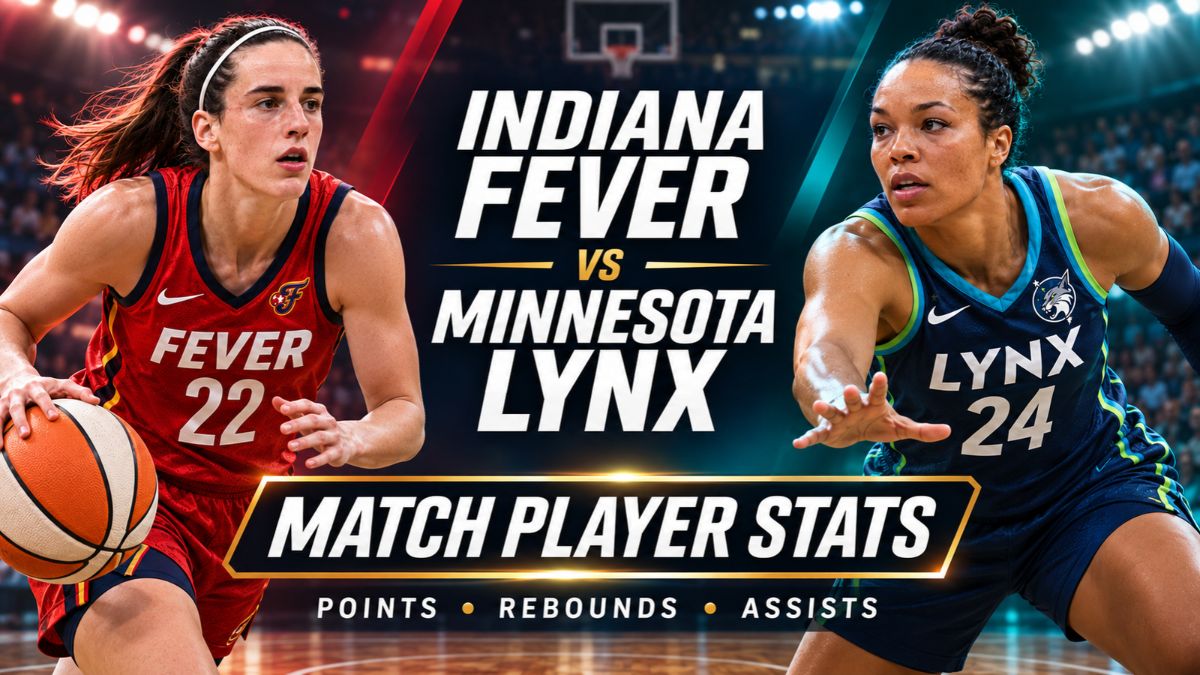
One strong shooting night can change a basketball game, but the full box score shows much more. The Indiana Fever vs Minnesota Lynx Match Player Stats from September 24, 2026, tell the story of Minnesota’s 86–66 win at Target Center in Minneapolis. Kayla McBride led the scoring, Natasha Howard finished well around the basket, and Courtney Williams supplied the assists. Indiana received useful work from its reserves but struggled to score early. This article covers that specific regular season matchup, with player numbers, team shooting figures, and simple explanations of what the results mean.
Match Date, Venue and Final Score
Minnesota hosted Indiana on September 24, 2026, in the final regular season game for both teams. The Lynx finished with 86 points, while the Fever scored 66. Minnesota ended the regular season at 33–11, and Indiana finished at 28–16. Those records provide context, but the numbers below describe this game alone.
The first step when reading Indiana Fever vs Minnesota Lynx Match Player Stats is checking the date. These teams meet more than once, so a player’s strong performance in another meeting does not belong in this box score. Keeping the game date clear also prevents season averages from being mistaken for single-game totals.
Indiana Fever Key Player Stats (September 24, 2026)
| Player | Points | Rebounds | Assists |
|---|---|---|---|
| Kelsey Mitchell | 10 | 2 | 1 |
| Caitlin Clark | 2 | 4 | 3 |
| Aliyah Boston | 4 | 3 | 0 |
| Monique Billings | 6 | 10 | 1 |
| Raven Johnson | 6 | 3 | 4 |
Minnesota Lynx Key Player Stats (September 24, 2026)
| Player | Points | Rebounds | Assists |
|---|---|---|---|
| Kayla McBride | 22 | 2 | 3 |
| Natasha Howard | 21 | 8 | 2 |
| Courtney Williams | 9 | 7 | 10 |
| Napheesa Collier | 6 | 7 | 3 |
| Maya Caldwell | 5 | 5 | 4 |
How the First Half Shaped the Game
Minnesota led 32–13 after the first quarter and 62–32 at halftime. The Lynx then won the third quarter 14–9. Indiana took the fourth quarter 25–10, which reduced the final margin to 20 points. The late scoring made the result closer than the halftime gap.
This matters when comparing players. A basket scored during an early run can change the game’s direction. A basket scored with a large deficit still counts, but it comes in a different setting. Read the quarter scores alongside the final player totals to understand when each team gained its advantage.
Kayla McBride Led All Scorers
Kayla McBride scored 22 points, collected two rebounds, and added three assists. She made eight of 13 field goal attempts, including six of 10 from three-point range. Her overall shooting percentage was 61.5%, and her three-point percentage was 60.0%. She did not need a free throw to reach her total.
Her scoring line stands out in the Indiana Fever vs Minnesota Lynx Match Player Stats because it combines volume with accuracy. Looking only at points would miss that detail. When comparing scorers, check how many shots they needed and where those shots came from. A player who scores efficiently leaves more possessions available for teammates.
Natasha Howard Scored Efficiently Inside
Natasha Howard finished with 21 points, eight rebounds, and two assists. She made nine of 11 shots from the field and three of four free throws. Her rebounding total included four offensive boards. She also recorded three blocks, giving her a strong line at both ends.
Howard’s numbers offer a useful example of why points and rebounds belong together in a match review. An offensive rebound keeps a possession alive after a miss. A block can stop a shot, although it does not always give the defending team possession. These plays explain contributions that a scoring total alone cannot show.
Courtney Williams Created Chances for Teammates
Courtney Williams had nine points, seven rebounds, and a game-high 10 assists. She made four of seven field goal attempts, including one of two three-point shots. She also had four turnovers. Her assist total was the clearest sign of her role in helping Minnesota create baskets.
Williams is an important part of the Indiana Fever vs Minnesota Lynx Match Player Stats even though she did not reach double figures in scoring. Assists show successful passes that lead to made baskets. They do not measure every good pass, however, because a teammate must finish the chance for an assist to be recorded.
Napheesa Collier and Maya Caldwell Added Support
Napheesa Collier recorded six points, seven rebounds, and three assists. Maya Caldwell supplied five points, five rebounds, and four assists. Both players contributed in several areas, even though neither matched the scoring totals of Minnesota’s leading pair. Their lines help explain how responsibilities were shared across the starting group.
A useful review gives space to this kind of support. A player can help by collecting a defensive rebound or finding an open teammate without finishing the possession herself. At the same time, modest scoring should still be described honestly. A balanced assessment recognises useful contributions without turning every stat line into a standout performance.
Kelsey Mitchell and Caitlin Clark Had Difficult Shooting Nights
Kelsey Mitchell led Indiana with 10 points, two rebounds, and one assist. She made three of 12 shots, including two of six three-point attempts, and converted both free throws. Caitlin Clark finished with two points, four rebounds, and three assists. Clark shot one of 12 from the field and missed all seven three-point attempts.
These Indiana Fever vs Minnesota Lynx Match Player Stats show why attempts are as important as points. Both guards had trouble turning shots into baskets. Still, this was one game, so it should be treated as a record of that evening. It does not replace a wider review of their performances across the season.
Boston, Hull and Timpson in the Starting Group
Aliyah Boston finished with four points and three rebounds in 13 minutes and one second. Lexie Hull added five points and four rebounds. Makayla Timpson recorded two points, one rebound, one steal, and one block in eight minutes and 53 seconds. None of the three recorded an assist.
Minutes help put those totals in context. A player with a short appearance has fewer chances to collect rebounds, take shots, or make passes. However, the box score alone cannot explain every coaching decision or substitution. Avoid guessing why a player’s minutes were limited when the numbers only show how long she played.
Monique Billings Led the Rebounding
Monique Billings collected a game-high 10 rebounds for Indiana, including six offensive rebounds. She also scored six points on three-of-five shooting and recorded one assist. She produced those numbers in 17 minutes and 11 seconds, giving the Fever a useful rebounding contribution from the bench.
Billings deserves attention in the Indiana Fever vs Minnesota Lynx Match Player Stats because her strongest work came outside the main scoring column. Offensive boards create another chance to attack. They do not guarantee points, though. To judge their full value, look at whether the next shot, pass, or trip to the free throw line produces a result.
Indiana’s Other Reserves Filled Several Roles
Raven Johnson contributed six points, three rebounds, four assists, and three steals. Grace VanSlooten scored nine points and collected two rebounds. Bree Hall added eight points, five rebounds, and one assist. Those three lines show different forms of bench production, from passing and defensive activity to scoring and rebounding.
Myisha Hines-Allen added six points, two rebounds, and one assist. Tyasha Harris finished with four points and two assists, while Michelle Onyiah had four points and five rebounds. Sophie Cunningham collected two rebounds but did not score. Together, Indiana’s reserves provided 43 points, compared with 23 from its starters.
Minnesota’s Bench Added Outside Shooting
Nia Brodie scored nine points, with all three of her made field goals coming from beyond the arc. She also collected four rebounds and two assists. Aari McDonald added eight points, one assist, and two steals. Their scoring provided support behind Minnesota’s leading starters.
The remaining Minnesota reserves also appear in the Indiana Fever vs Minnesota Lynx Match Player Stats. Antonia Delaere recorded two points, five rebounds, and one assist. Dorka Juhász added two points, two rebounds, and one assist. Liatu King scored two points with one rebound, while Chloe Bibby had three rebounds and one assist without scoring.
Three-Point Shooting Explained Much of the Gap
Minnesota made 15 of 40 three-point attempts, shooting 37.5%. Indiana made five of 32, shooting 15.6%. That gave the Lynx 45 points from three-pointers and the Fever 15. Minnesota also finished at 44.0% overall from the field, compared with Indiana’s 34.2%.
The Indiana Fever vs Minnesota Lynx Match Player Stats therefore show a clear difference in outside shooting. The 30-point gap from three-pointers exceeded the final margin, but that is a scoring comparison, not a claim that every other part of the game was equal. Two-point baskets and free throws also formed part of the final score.
Assists, Turnovers and Ball Movement
Minnesota finished with 28 assists, while Indiana recorded 13. The Lynx had 13 player turnovers, compared with 15 for the Fever. Williams led Minnesota’s passing numbers, and Johnson had Indiana’s highest assist total. The team figures support the view that Minnesota connected more successful passes with made baskets.
When reading Indiana Fever vs Minnesota Lynx Match Player Stats, avoid treating assists as a complete measure of teamwork. A good pass can lead to a missed shot and produce no assist. Likewise, a turnover can come from a difficult pass, a handling mistake, or another violation. The totals identify patterns, while the play-by-play explains individual moments.
Understanding the Rebounding Totals
Adding the individual player rebounds gives Indiana 43 and Minnesota 44. Indiana’s players collected 16 offensive rebounds and 27 defensive rebounds. Minnesota’s players had 10 offensive and 34 defensive rebounds. Billings led all players, while Howard had Minnesota’s highest individual total.
Some displays also include team rebounds, which are not credited to an individual player. That can produce a different team total from the sum of the player rows. When comparing Indiana Fever vs Minnesota Lynx Match Player Stats across websites, check whether both displays use the same method. A difference in presentation does not automatically mean a player’s total is wrong.
Free Throws and Bench Points Need Context
Indiana made 11 of 20 free throws, while Minnesota converted five of six. The Fever therefore scored more points at the line but missed more opportunities there. Indiana also received 43 bench points, compared with Minnesota’s 23. Those figures show that the losing team can lead useful categories.
Bench scoring needs particular care in a game with a large early gap. Minnesota removed its starters during the second half, and the reserves received more time late. That setting changes how the bench totals should be read. Compare who was playing and the score at the time before using reserve points as proof of overall team strength.
How to Read Minutes and Plus-Minus Fairly
Plus-minus shows the change in the score while a player is on the court. For example, a plus-six figure means her team scored six more points than the opponent during her minutes. It does not mean she personally created a six-point advantage. Teammates, opponents, and the combinations on the floor all affect it.
For a fair player comparison, begin with minutes, then check scoring attempts, rebounds, assists, and turnovers. Use plus-minus as extra context after those details. Short appearances can produce sharp changes that are hard to judge alone. Watching the relevant possessions is especially useful when two players have similar basic totals but very different roles.
Conclusion
The Indiana Fever vs Minnesota Lynx Match Player Stats from September 24, 2026, show a game shaped by Minnesota’s early lead and stronger shooting. McBride led the scoring, Howard combined efficient finishing with rebounding, and Williams created chances through her passing. Billings and several Indiana reserves supplied useful contributions. The best way to understand the result is to read points, rebounds, and assists together, then add shooting attempts, minutes, and quarter scores. That gives a clearer picture than choosing a player’s impact from one number.
(FAQ’s)
1. Who won the September 24, 2026 game?
Minnesota beat Indiana 86–66 at Target Center.
2. Who scored the most points?
Kayla McBride led all players with 22 points.
3. Who had the most rebounds?
Monique Billings collected 10 rebounds, including six offensive boards.
4. Who recorded the most assists?
Courtney Williams led the game with 10 assists.
5. How many points did Caitlin Clark score?
Clark finished with two points, four rebounds, and three assists.
You may also read: Lakers vs Detroit Pistons Match Player Stats With Points, Rebounds and Assists Compared
Visit for more additional information: Zellow Magazine